Tag: news

  • Why your fundraising needs a strong offer

    In fundraising, a strong offer is a clear statement about what your donor will do and what she’ll receive in return.

    It’s the deal, the transaction, the quid pro quo. But it’s something more, too. Your offer is the emotional link between your donor and your nonprofit’s mission. It’s an expression of your donor’s aspirations about being a good person and the validation of those aspirations, all put into action through the work your nonprofit does.

    To be effective, your offer should do a number of things. It should present donors with a specific opportunity to do good. It should convey donor benefits, which can be tangible (like a premium) and intangible (like making a difference). It should tell your donor what to do and why. It should convey some sense of urgency, either implied or explicit (like a specific deadline to respond). And it should show your donor that she’s getting a good deal.

    You want to incorporate as many of these “shoulds” as you can when crafting your offer. That might seem like a tall order at first. But once you get into it, you see that the strongest offers are often the simplest, such as, “Your gift of $25 will save the life of a starving child in Africa,” “Your gift will double in impact to send lifesaving medicine into poverty zones in Tajikistan,” or “Just $1.75 will provide a Thanksgiving dinner for someone who’s homeless.”

    Granted, getting to this level of simplicity isn’t always easy, but it’s worth the effort. You naturally want your offer to be as donor-focused as possible. So take the time to think about the most enticing opportunity you can present to your donors that allows them to fulfill their need to be good people making a difference in the world.

  • When not to use a freemium in direct mail fundraising

    Why would a nonprofit tout their stewardship of donors’ money in an appeal and then throw in a bunch of free stuff?

    Not sure.

    But that’s what this one did. The appeal is from an international aid and relief charity. The letter begins:

    “Trust, impact, and value are critical when you’re making decisions about giving to a charity.” No argument there. Most donors would probably accept that premise. It continues:

    “You want to know that your hard-earned money is being put to the best use.” This is where it gets weird. This mailing includes a freemium, and that freemium is five full-size, full-color, single-fold greeting cards with five envelopes.

    Now, is that the most extravagant freemium ever? Not by a long shot. Some nonprofits throw in address labels, calendars, note pads, and much more all into one mailing. But this particular freemium isn’t exactly the cheapest either. It’s not a simple bookmark, for example.

    The point is, if you’re throwing in free stuff, is that the appeal where you want to get on your high horse about putting donors’ hard-earned money to the best use? We all know that most donors will just throw away all those greeting cards. Donors themselves probably realize that too. So from the donor’s perspective, how is that the best use of donors’ money?

    There could be a time and place for messaging that talks about trust, value, and so on. But that messaging seems at odds with adding a bunch of freemiums.

    Especially when those freemiums don’t relate directly to the offer of the appeal. True, these greeting cards show images of various countries and include small blurbs about the charity’s work. But still, they’re just greeting cards.

    Some extras to include in an appeal that might be a little more on point would be an infographic card, a map, a fact sheet, an impact report, photos of aid recipients, handwritten notes from a field worker or a beneficiary, and others. Things like these might be more relevant to donors and would relate more directly to what the nonprofit does and what the donor’s impact would be.

    Otherwise, it could look like you’re using free stuff to guilt donors into giving. And even if you’re doing that, and some nonprofits do (no judgement), you probably shouldn’t make the theme of the appeal how good you are with donors’ money. Because the free stuff makes that seem less believable.

  • How two nonprofits are reacting in the Trump era

    Lately, many nonprofits are finding that they have to worry about something they never even considered before.

    Sure, they had the usual worries about donor attrition, revenue, acquisition, retention, and so on.

    But now, on top of all that, they have to worry that the federal government might be coming after them.

    “The Trump administration is mounting a sweeping offensive on America’s nonprofit sector, deploying a blend of funding cuts, the elimination of tax benefits, bureaucratic paralysis and even installing a small DOGE team to target organizations that challenge the president’s agenda,” according to Politico (4/18/2025).

    At least two nonprofits are reacting in the best way there is – with direct mail.

    Take the Environmental Defense Fund. The Trump administration has canceled or interrupted hundreds of EPA grants, shut down more than 100 climate studies, and ended National Science Foundation grants for projects related to climate change. These cuts directly affect the EDF.

    So they’re firing up their donors.

    EPSON MFP image

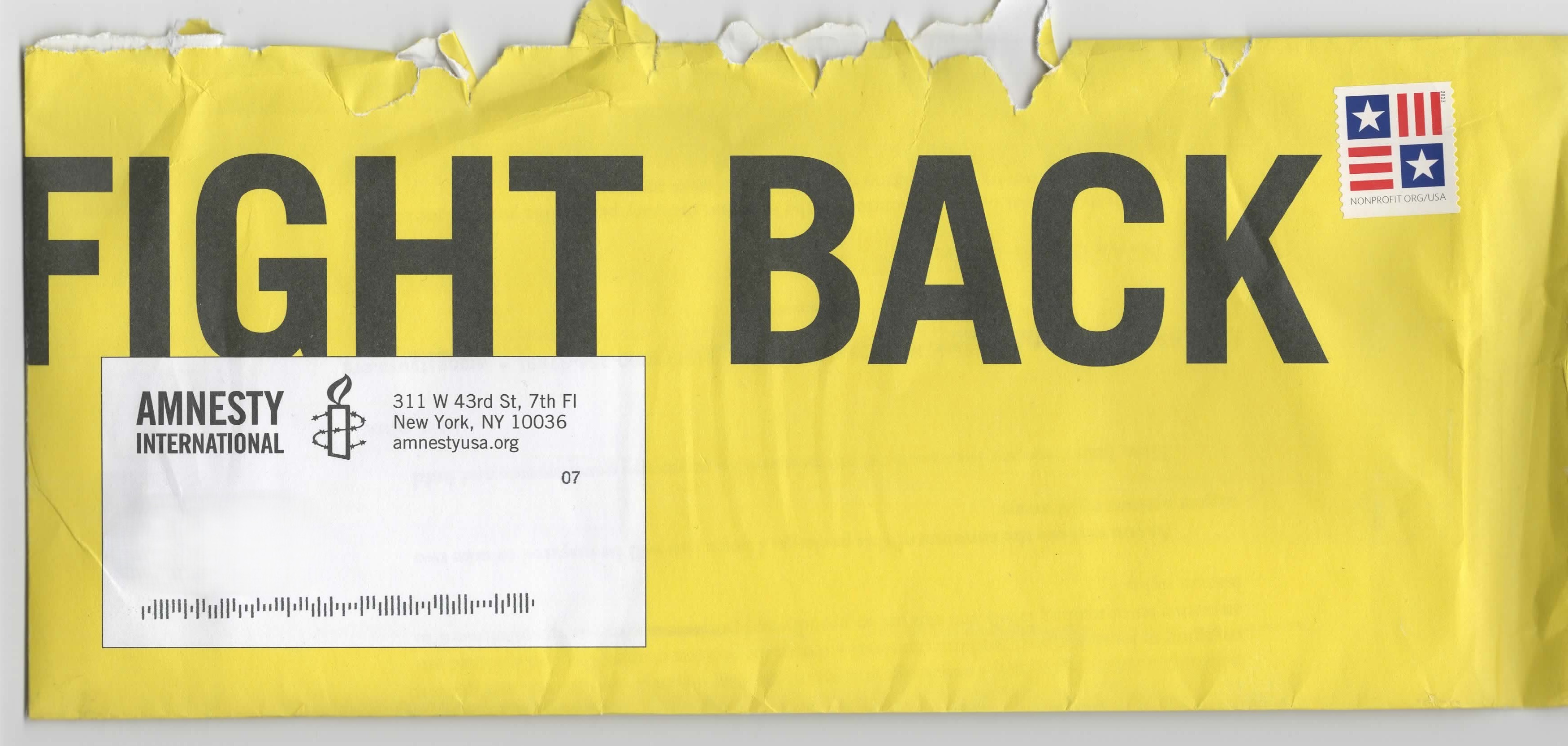
    Amnesty International is another example. The Trump administration stopped U.S. foreign aid, halting programs for health care, food security, shelter, and humanitarian support. And ended  funding for programs supporting survivors of sexual violence, refugees, and marginalized communities.

    Amnesty International has said that these cuts will leave millions without essential services.

    So they’re firing up their donors too.

    EPSON MFP image

    Both of these appeals are following a bold, in-your-face strategy to get noticed, get the appeal opened, and move donors.

    There’s the oversize outer envelope (11” x 5” for one and 11-1/2” x 5 for the other).

    There’s the simple, powerful messaging on the outer envelope: “Fight Back!”

    There’s the bold graphic approach, with huge fonts and attention-grabbing reds and yellows.

    And there’s the invitation to take action. The Amnesty International carrier touts an “activist tool kit inside.” And the Environmental Defense Fund envelope announces, “Petitions Inside!”

    Inside, the letters continue the “take action” theme, urging donors to donate and to get involved.

    You can see the strategy in both of these outer envelopes. They’re all about demanding attention, increasing the open rate, and getting donors motivated. When you see an appeal envelope like this in your mailbox, you know it’s something important. Your interest has been piqued. Your ire has been roused. And your means for fighting back are right at hand, inside the envelope.

    These are tactics and strategies that virtually all nonprofits could use in their appeals, especially now when there’s so much chaos and uncertainty.

    That’s why, as this turmoil continues and as the economy inches closer toward recession, nonprofits will have to grab donors’ attention and motivate them like never before. And that means direct mail tactics likes these will become necessary not only for success but also for survival.

    See the whole story at https://www.nonprofitpro.com/post/how-2-nonprofits-are-using-direct-mail-to-get-donors-fired-up-to-take-action/