Tag: writing

  • What’s the right envelope strategy for direct mail fundraising?

    People in the direct mail fundraising world are often surprisingly unanimous about one thing.

    The blank envelope is the way to go if you want increased open rates and response. Far better than any envelope with teaser copy and possibly graphics.

    “I’ve tested it!” they exclaim. Well maybe. The fact is that an A/B test is a snapshot in time, not a pronouncement from the oracle.

    And they never tell you what the teaser was that lost in the test. Maybe it was just bad teaser copy.

    But never mind about test results and data. You can see for yourself how you personally would react to two different envelope treatments. Is this a scientific test? Nope. But it does show how people might react, and you’re certainly a person. So let’s take a look at a brief thought experiment.

    You’re sorting through your morning mail. You see a stark, plain, blank envelope. Is it a bill? An overdue notice? A letter from the IRS? Could be any of those things or none of them. You don’t know. And that, say the blank-envelope proponents, is the point. You have to find out.

    Fair enough. What IS inside, which you don’t know at this point, is a letter from an organization wanting to sue President Trump. Let’s not get caught up in the politics here. This is about envelope teasers, remember.

    So you open the envelope, read the letter, and possibly donate. But you have to open the envelope, not knowing what to expect, and then decide whether to read it or not. There’s a disconnect there, between what the envelope conveys and what the message of the letter is.

    One of John Caples’s principles of copywriting is that the headline should directly and telegraphically lead into the body copy. Here we have no headline – or for our purposes, no teaser — so telegraphing isn’t possible.

    Which leads us to the counter example. You’re sorting through your mail again, and you see an envelope with this teaser, and it’s personalized: “John, we’re suing Donald Trump.”

    That’s it. No photo, no graphic. This teaser does what no blank envelope could ever accomplish. It primes the reader for what’s to come in the letter enclosed. Even more to the point, if you’re the target audience for this appeal, you’re already halfway toward donating simply by reading that teaser, even before you see the appeal letter.

    Instead of being hesitant to see what’s inside, as you might be with a blank envelope, in this case you’re eager to see the letter because you’re already in agreement with what the letter will presumably talk about. The envelope and the letter are working together. They’re direct and telegraphic.

    If you’re the nonprofit sending out this appeal, you’ve primed the donor with the envelope teaser, and when you follow through in the appeal letter, you’re well on your way to winning a donation.

    To see a lot more on this, go to https://tinyurl.com/44ystvan

  • AI has gutted nonprofit telemarketing. Will it do the same to donor communications?

    If you give to nonprofits, in addition to mail and email appeals, you probably receive phone calls thanking you for your last gift and asking you to give again. In the before times, before AI, the person on the other end of the phone was a person.

    Not anymore. Now the person on the other end is an AI robot. Here’s how it goes. Your phone rings. You answer. First thing you hear is muffled voices and commotion in the background, as if the call is coming from the command center of a very busy organization. That’s all fake, of course. There’s no command center. There’s no organization. There’s not even a call center where people work. They’ve all been replaced by AI.

    Then, you hear this: “Hi this is Mike, I’m calling you about [charity name].” He launches into his spiel. “We’re a national organization working on behalf of police officers who get injured on the job.”

    You immediately think that this is of course important work. “Mike” goes on to explain that policing is dangerous, and officers are getting injured at a much higher rate than at any other time.

    All the while “Mike” is talking, he sounds conversational and even friendly. He doesn’t sound like a robot, and yet he doesn’t really sound like a human being either. Something just seems slightly off, but you can’t really put your finger on it.

    “Mike” finishes his pitch, then says, “Can I count of you for a pledge of $20?”

    You might give, but you’re thinking about it. So you ask “Mike” what the name of the charity is again. He tells you. You ask how long they’ve been running. He tells you.

    Then you ask, “Mike, what will my donation do?” Long pause. “Mike” is glitching. He tells you that the charity helps injured police officers.

    You say, “Yes, I know, but what will my donation accomplish?” Another pause. “I think it’d be helpful to look at our website at www[URL].”

    You realize that something is up with “Mike.” So you say, “Mike, are you a robot?”

    He answers that question the same way that all the “Mikes” answer. He says with a chuckle, “Why do I sound that bad today?”

    Yes, Mike, you do. After you’ve talked with a few “Mikes,” are you ever going to take a call from that nonprofit again and actually talk with them about past and future gifts? No, you won’t.

    Because the interaction with “Mike” is impersonal. Because it’s deceptive. He’s passing himself off as a human being. Because it’s devoid of any real human feeling. And above all else, because “Mike” is an AI robot and you’re a person.

    Something very similar is the case with AI-generated appeals that donors might get in the mail and in email. They’re impersonal. They’re deceptive. They’re passing themselves off as written by a human. They’re devoid of real feeling. And they’re computer generated while you’re not.

    Even worse, they’re boring. The only thing that AI can do when writing fundraising copy is provide a facsimile of all the fundraising copy it has aggregated. That means what AI is spitting out is the average, the status quo, the expected. It’s templated language.

    It’s not going to provide something new and unexpected. It’s not going to give you a breakthrough idea. It’s not going to really engage donors.

    Not only that, because it only produces what it has aggregated, the output all tends to sound pretty much the same. Which means that your nonprofit starts sounding like all the other nonprofits that are using AI.

    Sure, nonprofits can pump out lots of appeals with AI. Even small nonprofits can do that. But is it a good idea?

    Think of it from your donors’ perspective. You’re on the receiving end. Once you’ve had a few phone calls with “Mike,” you’re simply going to stop picking up the phone. Because why would you bother?

    And once you’ve read a few soul-less, Mike-like, AI-generated appeal letters, are you going to keep opening up the appeal letters and emails from that nonprofit? Why would you bother?

    Yes, AI is a new and disruptive technology. But before we get carried away with creating appeals easier, faster, and cheaper just because we can, let’s give a thought to the donors we’re creating the appeals for. And let’s ask, “How would I like it if I were the one getting fake phone calls and letters from ‘Mike’? Would that make me more likely to give or less likely?”

  • How two nonprofits are reacting in the Trump era

    Lately, many nonprofits are finding that they have to worry about something they never even considered before.

    Sure, they had the usual worries about donor attrition, revenue, acquisition, retention, and so on.

    But now, on top of all that, they have to worry that the federal government might be coming after them.

    “The Trump administration is mounting a sweeping offensive on America’s nonprofit sector, deploying a blend of funding cuts, the elimination of tax benefits, bureaucratic paralysis and even installing a small DOGE team to target organizations that challenge the president’s agenda,” according to Politico (4/18/2025).

    At least two nonprofits are reacting in the best way there is – with direct mail.

    Take the Environmental Defense Fund. The Trump administration has canceled or interrupted hundreds of EPA grants, shut down more than 100 climate studies, and ended National Science Foundation grants for projects related to climate change. These cuts directly affect the EDF.

    So they’re firing up their donors.

    EPSON MFP image

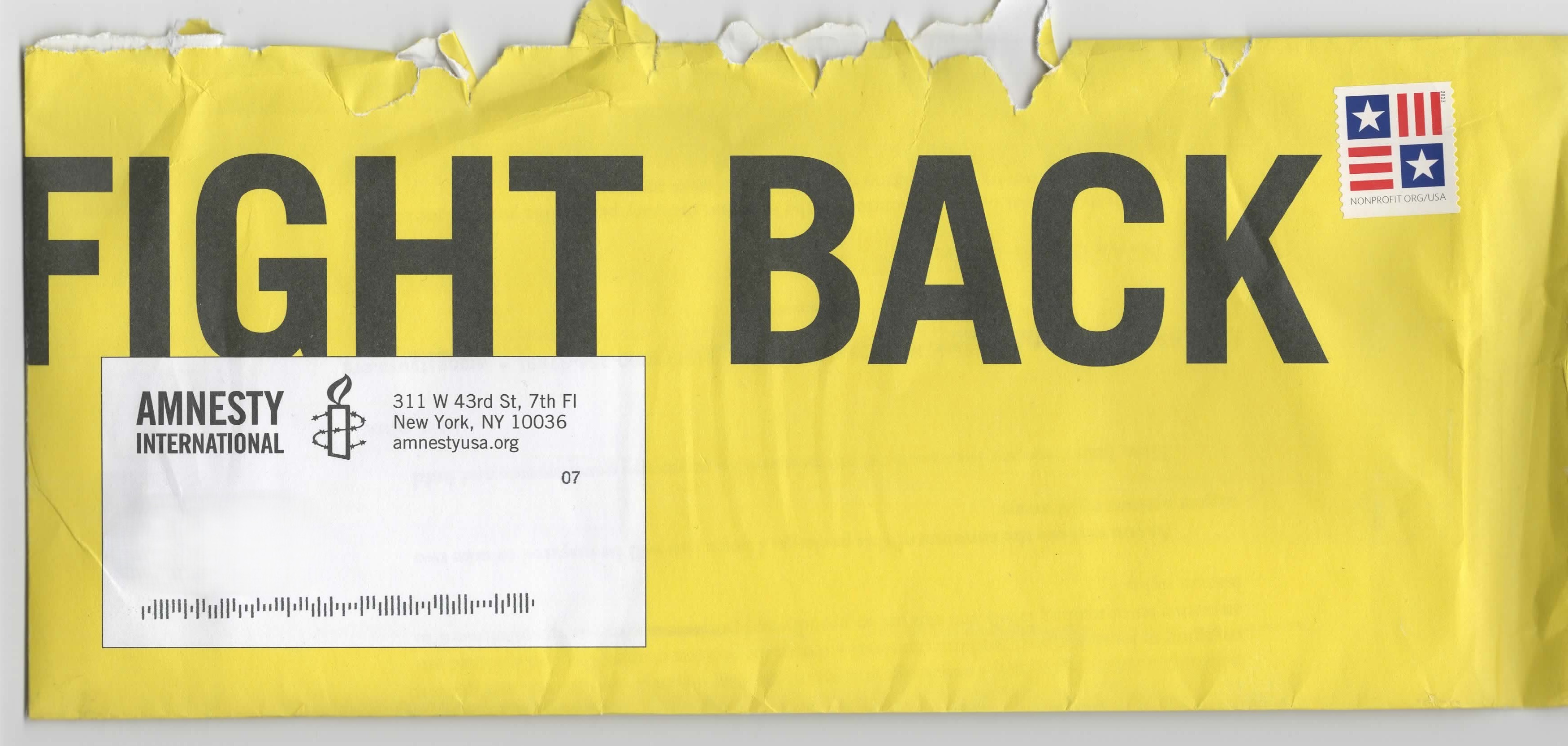
    Amnesty International is another example. The Trump administration stopped U.S. foreign aid, halting programs for health care, food security, shelter, and humanitarian support. And ended  funding for programs supporting survivors of sexual violence, refugees, and marginalized communities.

    Amnesty International has said that these cuts will leave millions without essential services.

    So they’re firing up their donors too.

    EPSON MFP image

    Both of these appeals are following a bold, in-your-face strategy to get noticed, get the appeal opened, and move donors.

    There’s the oversize outer envelope (11” x 5” for one and 11-1/2” x 5 for the other).

    There’s the simple, powerful messaging on the outer envelope: “Fight Back!”

    There’s the bold graphic approach, with huge fonts and attention-grabbing reds and yellows.

    And there’s the invitation to take action. The Amnesty International carrier touts an “activist tool kit inside.” And the Environmental Defense Fund envelope announces, “Petitions Inside!”

    Inside, the letters continue the “take action” theme, urging donors to donate and to get involved.

    You can see the strategy in both of these outer envelopes. They’re all about demanding attention, increasing the open rate, and getting donors motivated. When you see an appeal envelope like this in your mailbox, you know it’s something important. Your interest has been piqued. Your ire has been roused. And your means for fighting back are right at hand, inside the envelope.

    These are tactics and strategies that virtually all nonprofits could use in their appeals, especially now when there’s so much chaos and uncertainty.

    That’s why, as this turmoil continues and as the economy inches closer toward recession, nonprofits will have to grab donors’ attention and motivate them like never before. And that means direct mail tactics likes these will become necessary not only for success but also for survival.

    See the whole story at https://www.nonprofitpro.com/post/how-2-nonprofits-are-using-direct-mail-to-get-donors-fired-up-to-take-action/

  • Grammar rules you can’t break in fundraising copy and some you can

    Grammar rules? For fundraising copy?

    Yes.

    Hold on a minute. Shouldn’t fundraising copy be all informal and conversational? And doesn’t “conversational” mean that we routinely break so-called grammar rules and begin sentences with “and” or “but,” use contractions, end sentences with prepositions, and more?

    Yes to that too.

    But still, there are some grammar rules you can’t break, simply because breaking them causes confusion for readers – and that we definitely don’t want. Here are three of those unbreakable rules (from my article in NonProfitPRO: https://tinyurl.com/4pnwtpx8).

    The dangling modifier. Take this example: “It’s so easy to forget that plants are quiet miracles. Often small, underfoot, and seemingly plentiful, we overlook their clever design and chemical superpowers.” In the second sentence, the phrase “Often small, underfoot, and seemingly plentiful” modifies “we” when it should modify “plants.” It’s not we who are often small, underfoot, and seemingly plentiful. It’s plants. This error is really common, but it causes a lot of confusion for readers.

    Subject-verb agreement. You wouldn’t say “Children in Darfur is starving,” you’d say, “Children in Darfur are starving.” That’s pretty obvious subject-verb agreement. The problem comes in when other phrases get in the way. Take this example: “A shipment of lifesaving vaccines are being unloaded now in Africa.” The problem is that the subject of the sentence is “shipment,” not “vaccines.” The verb has to agree with “shipment.” That sentence should be “A shipment of lifesaving vaccines is being unloaded…” not “are being unloaded.”

    Run-on sentence. This is when two sentences are jammed together without the right punctuation, as in: “Too many seniors are struggling with hunger and isolation, they need the help that your gift provides.” That comma is linking those two separate ideas. It’s an error called a comma splice. They should really be linked with a semicolon, or better yet, they should be two separate sentences.

    A grammatical error in fundraising copy isn’t the end of the world, of course. Still, errors like these can cause confusion and distract donors from the fundraising message. And when that happens, you’re more likely to lose the donation instead of winning it.

  • Why is the copy for direct response fundraising so weird?

    It’s not weird, really. But it is way different from academic, business, or journalistic writing, and so it can seem weird to the (uninitiated) people at nonprofits who review copy.

    As my article in NonprofitPRO points out:

    Good copy is simple. It uses short words, sentences, and paragraphs, without jargon. That doesn’t mean it’s dumbed down, as some nonprofits think. That means it’s plain talk, which everyone appreciates, including donors.

    Good copy is repetitive. You need to repeat the important points, because most donors don’t read a letter or email from front to back. They skim. Repeating key concepts means you have a better chance of grabbing attention.

    Good copy is dramatic. To get donors’ attention and keep it, copy has to have emotional content. It has to have drama. But then it’s seen as over the top by some at the nonprofit. That’s too bad. Toning down the copy just leads to boring copy. As David Ogilvy said, “You can’t bore people into buying.” Well you can’t bore them into giving either.

    Direct response copy is the way it is because that’s what donors respond to. You can see more about why this is the case by clicking here.