Tag: advertising

  • How to harness the power of good to make your fundraising appeals better

    Many nonprofits aren’t giving donors what they want.

    And then those same nonprofits wonder why donors aren’t giving them what THEY want – donations.

    Donors want a whole range of things in exchange for their gifts. One of those things surely is the intangible benefit of thinking of oneself as a good person.

    And why not? Why shouldn’t donors think of themselves this way? Donors ARE good people for giving.

    But many nonprofits fail to tap into this in their fundraising appeals. Maybe they think it’s too sentimental or too melodramatic. Nonsense.

    You want to connect with your donors on a practical level (I’m sending food for starving people), but you also want to connect with donors on an emotional level (I’m doing something good that I can be proud of, something that shows I’m a good person.).

    So how do you communicate this important intangible benefit to donors?

    There’s the tried-and-true donor appreciation certificate with the donor’s name on it, saying how wonderful they are. That says, “you’re a good person for giving.”

    There are special awards, like a Good Neighbor Award, that send the good-person message.

    There are impact reports saying, “you made this good work possible,” which the donor understands as “I’m a good person for doing this.”

    There are memberships in giving groups, like president’s clubs, where donors can see themselves as good people in the company of other good people

    There’s messaging. You can suggest, you can imply, you can even come right out and say, “You’re a good person!” in donor communications.

    There are many more ways to convey to donors that they’re good people. And when you give donors what they want, they’re more likely to return the favor. See the whole story at https://tinyurl.com/28e4pkjp

  • When not to use a freemium in direct mail fundraising

    Why would a nonprofit tout their stewardship of donors’ money in an appeal and then throw in a bunch of free stuff?

    Not sure.

    But that’s what this one did. The appeal is from an international aid and relief charity. The letter begins:

    “Trust, impact, and value are critical when you’re making decisions about giving to a charity.” No argument there. Most donors would probably accept that premise. It continues:

    “You want to know that your hard-earned money is being put to the best use.” This is where it gets weird. This mailing includes a freemium, and that freemium is five full-size, full-color, single-fold greeting cards with five envelopes.

    Now, is that the most extravagant freemium ever? Not by a long shot. Some nonprofits throw in address labels, calendars, note pads, and much more all into one mailing. But this particular freemium isn’t exactly the cheapest either. It’s not a simple bookmark, for example.

    The point is, if you’re throwing in free stuff, is that the appeal where you want to get on your high horse about putting donors’ hard-earned money to the best use? We all know that most donors will just throw away all those greeting cards. Donors themselves probably realize that too. So from the donor’s perspective, how is that the best use of donors’ money?

    There could be a time and place for messaging that talks about trust, value, and so on. But that messaging seems at odds with adding a bunch of freemiums.

    Especially when those freemiums don’t relate directly to the offer of the appeal. True, these greeting cards show images of various countries and include small blurbs about the charity’s work. But still, they’re just greeting cards.

    Some extras to include in an appeal that might be a little more on point would be an infographic card, a map, a fact sheet, an impact report, photos of aid recipients, handwritten notes from a field worker or a beneficiary, and others. Things like these might be more relevant to donors and would relate more directly to what the nonprofit does and what the donor’s impact would be.

    Otherwise, it could look like you’re using free stuff to guilt donors into giving. And even if you’re doing that, and some nonprofits do (no judgement), you probably shouldn’t make the theme of the appeal how good you are with donors’ money. Because the free stuff makes that seem less believable.

  • How two nonprofits are reacting in the Trump era

    Lately, many nonprofits are finding that they have to worry about something they never even considered before.

    Sure, they had the usual worries about donor attrition, revenue, acquisition, retention, and so on.

    But now, on top of all that, they have to worry that the federal government might be coming after them.

    “The Trump administration is mounting a sweeping offensive on America’s nonprofit sector, deploying a blend of funding cuts, the elimination of tax benefits, bureaucratic paralysis and even installing a small DOGE team to target organizations that challenge the president’s agenda,” according to Politico (4/18/2025).

    At least two nonprofits are reacting in the best way there is – with direct mail.

    Take the Environmental Defense Fund. The Trump administration has canceled or interrupted hundreds of EPA grants, shut down more than 100 climate studies, and ended National Science Foundation grants for projects related to climate change. These cuts directly affect the EDF.

    So they’re firing up their donors.

    EPSON MFP image

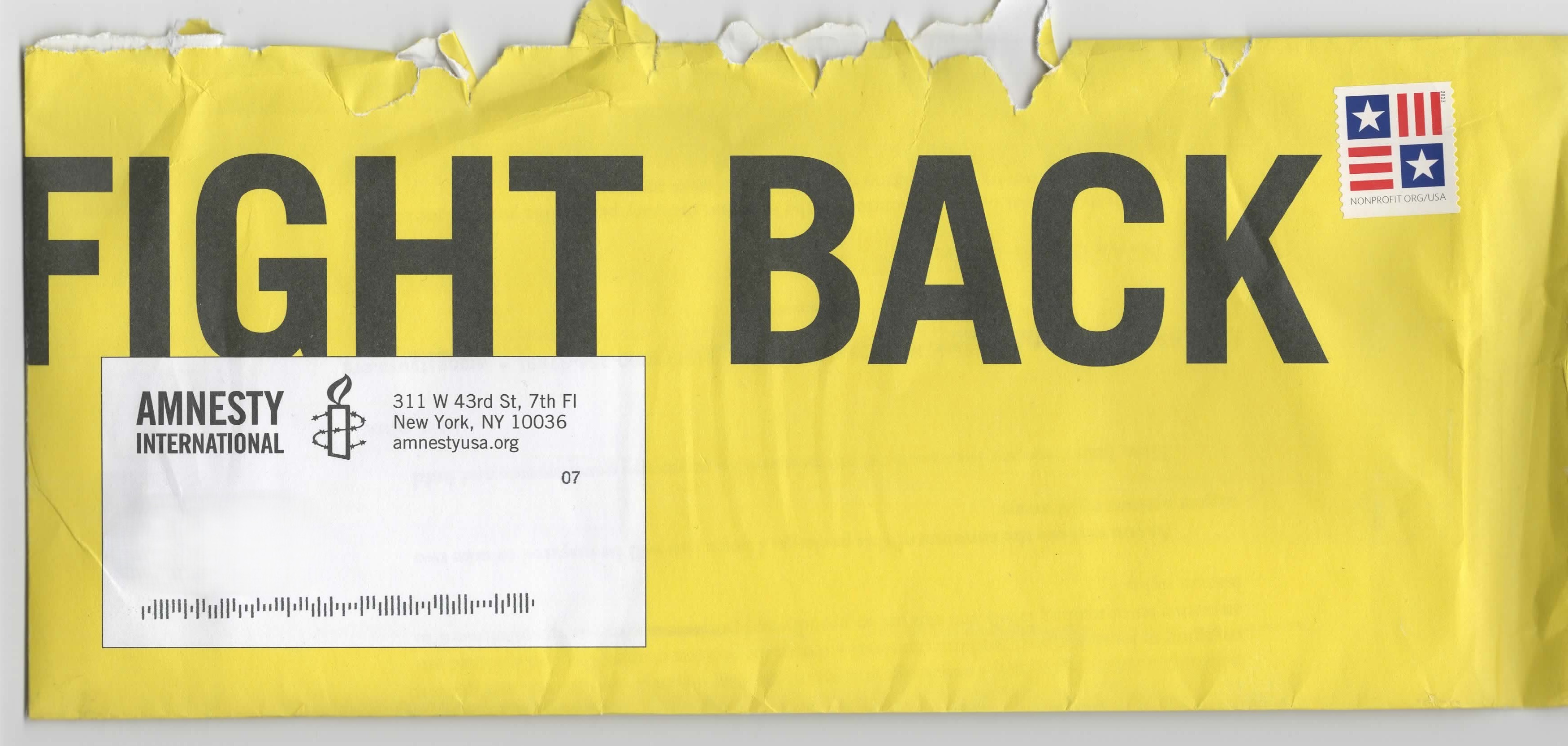
    Amnesty International is another example. The Trump administration stopped U.S. foreign aid, halting programs for health care, food security, shelter, and humanitarian support. And ended  funding for programs supporting survivors of sexual violence, refugees, and marginalized communities.

    Amnesty International has said that these cuts will leave millions without essential services.

    So they’re firing up their donors too.

    EPSON MFP image

    Both of these appeals are following a bold, in-your-face strategy to get noticed, get the appeal opened, and move donors.

    There’s the oversize outer envelope (11” x 5” for one and 11-1/2” x 5 for the other).

    There’s the simple, powerful messaging on the outer envelope: “Fight Back!”

    There’s the bold graphic approach, with huge fonts and attention-grabbing reds and yellows.

    And there’s the invitation to take action. The Amnesty International carrier touts an “activist tool kit inside.” And the Environmental Defense Fund envelope announces, “Petitions Inside!”

    Inside, the letters continue the “take action” theme, urging donors to donate and to get involved.

    You can see the strategy in both of these outer envelopes. They’re all about demanding attention, increasing the open rate, and getting donors motivated. When you see an appeal envelope like this in your mailbox, you know it’s something important. Your interest has been piqued. Your ire has been roused. And your means for fighting back are right at hand, inside the envelope.

    These are tactics and strategies that virtually all nonprofits could use in their appeals, especially now when there’s so much chaos and uncertainty.

    That’s why, as this turmoil continues and as the economy inches closer toward recession, nonprofits will have to grab donors’ attention and motivate them like never before. And that means direct mail tactics likes these will become necessary not only for success but also for survival.

    See the whole story at https://www.nonprofitpro.com/post/how-2-nonprofits-are-using-direct-mail-to-get-donors-fired-up-to-take-action/

  • Don’t hide from your donors — communicate with them

    You really should be mailing and emailing your donors more often. Why? Because…

    Your donors want to hear from you. They want to know what your nonprofit is doing. They want to know when their help is needed. They want to donate. And they expect to donate because they understand how nonprofits operate. If they didn’t, they wouldn’t be on your donor rolls in the first place.

    So, of course they expect to get your fundraising appeals. Still, what about the dreaded too-much-mail complaint?

    Simple. You can respond to it by respecting donors’ individual preferences. And offering them your sustainer program as an option for receiving less mail.

    Here’s the point: It does your nonprofit no good to restrict the appeals you send and hide from your donors. Your fundraising isn’t an intrusion in your donors’ lives, as some nonprofits seem to believe. Your fundraising is how you have a relationship with your donors. In fact, for most of your donors, your fundraising is all they’ll ever see of your nonprofit. Sure, some donors go to events, and some take the tour. But for most of your donors, your fundraising IS your nonprofit.

    And it’s pretty hard to have a strong relationship with your donors – let alone build your nonprofit’s brand — if they only hear from you once or twice a year.

    Then again, it’s not just about mailing more. It’s about mailing smarter too. That means:

    Asking your donors how often they want to hear from you and through what media, and honoring their preferences.

    Mailing less to lower-dollar donors.

    Mailing more to higher-dollar donors and using appeals with specialized messaging and production values.

    Letting lower-dollar lapsed donors go while reactivating higher-dollar lapsed donors.

    Adding extra appeals during high-response times like Christmas, Thanksgiving, and year end.

    And adding a donor-centric newsletter with success stories about your donor’s support at work.

    What it comes down to is this: You have to get your message in front of your donors – repeatedly. Otherwise, they’re likely to forget all about you. That’s a much greater risk than an occasional complaint about too much mail or email. You can see more here: https://tinyurl.com/yr7mwacw

  • How and why to get the copy voice right in fundraising appeals

    Why would a nonprofit, say, one fighting climate change, use messaging like this for a fundraising appeal. …

    Dear Ms. Joan Sample,

    I am writing to you today from [charity], a dedicated advocate for climate action and environmental sustainability. As you may know, our planet is facing unprecedented challenges due to climate change, and the need for immediate action has never been more urgent.

    At [charity], we are committed to combating climate change through innovative projects, community engagement, and policy advocacy. Our recent initiatives include installing an array of solar panels, which have already made a significant impact. However, to continue this vital work, we need your support.

    … when they could use messaging like this instead …

    Dear Ms. Joan Sample,

    I am writing this appeal on a hot July afternoon.

    My 11-month-old son is playing at my feet as I do. I look at Joe and I look at the blazing heat outside and I wonder how I can avoid talking about the greenhouse effect in nakedly personal terms. 

    But why shouldn’t I? Why shouldn’t I tell you how much I fear for the world we’re preparing for Joe?

    The first appeal reads like a corporate memo coming out of the accounting department at IBM. It’s predictable, bland, and deadly boring.

    The second one reads like it was written by an actual living, breathing, feeling person. It hasn’t been reviewed to death by a committee. It’s honest, relatable, personal, and human. When you read it, it draws you in. And even better, it makes you more receptive to whatever will follow.

    That’s the reaction we want to elicit from donors, and it comes from using an engaging copy voice. Many nonprofits struggle to get this right, for a number of reasons.

    They feel they have to speak to donors from a position of expertise and authority about the cause. But then the copy becomes long and pretentious.

    They use industry jargon and buzz words like “food insecure.” But then the copy confuses donors and keeps them at arm’s length.

    They think that the appeal letter has to sound like the president or executive director. But then the copy talks past donors, not at them, because what the president thinks is motivating often isn’t what donors think is motivating.

    What it comes down to is this: donors, like most people, respond best to plain talk. That’s why good fundraising copywriting is conversational. It’s write-like-you-talk writing. Simple words, short sentences, short paragraphs, with contractions, sentence fragments, and all the rest.

    The appeal should read like it was written by a friendly, thoughtful person who’s concerned about an issue and hopes the reader will be too. That human connection builds a rapport with donors. And that turns into a relationship with donors. And donors who have a relationship with your nonprofit will likely give more and give more often, which means increases in revenue and retention. You can see more here: https://tinyurl.com/ye269hxe

  • One of the main reasons why donors give

    It’s a strange quirk of nonprofits, but a lot of their fundraising seems intent on denying their donors the one thing that those donors want the most.

    Donors want action. They want something to be accomplished.

    Action on an issue that donors care about is one of the primary reasons for giving a gift. That issue could be hunger, poverty, homelessness, animal abuse, social justice, or any of a thousand others. Whatever it is, your donors are on your list because they want to see something get done.

    Stories, happy photos, sad photos, envelopes with teasers, envelopes without teasers – these things and many more like them are all a part of direct mail fundraising, and they’re all important.

    But when it comes down to the moment of truth, when a donor is deciding whether to give or not give, there’s a question in the donor’s mind, and that question is probably, Will my donation actually accomplish anything?

    So it’s curious why so many nonprofits send out fundraising appeals with offers based on vague generalizations like “give hope,” “stand with us,” “join our movement,” and “make a difference” instead of specifics on what the donor’s gift will do.

    You see this all the time. You get an appeal from a not-for-profit hospital asking you to donate. They could – emphasize could — ask you to fund something specific and actionable like a clinical trial for a new cancer drug. They could give you the opportunity to make something happen, create some kind of change, and move cancer research closer to the goal. That has a good chance of eliciting a donation.

    Instead, the appeal talks in vague generalities about enhancing the well-being of the community, how much the hospital cares about each and every resident, and how the hospital is the premier health system in the state. That has a good chance of eliciting a yawn.

    That’s because donors see through this nonsense and ambiguity. They want action. They want their donation to do something, to mean something. When the copywriting in a fundraising appeal clearly conveys what the donor can accomplish, you’re connecting with donors on the level of their personal values. And with that connection in place, donors are far more likely to reward your nonprofit with a gift. You can see more about this here: https://tinyurl.com/nhevffms

  • Give your donors a specific problem to solve

    Not sure why nonprofits do this…

    The teaser on the outer envelope is “Share hope this summer.” And the subhead is “See inside how you’re making an impact for neighbors like Ken.” There’s also a photo, presumably of Ken.

    This says practically nothing to a potential donor. It’s soft and mushy. It’s vague and abstract. And it fails to present a problem the donor can solve.

    In this case, the problem is real and specific. It’s life or death, in fact. People who are homeless will suffer and die in the searing heat of the summer, especially with temperatures soaring above 100 degrees.

    That’s what we’re talking about here. That’s the problem, and “Share hope this summer” doesn’t begin to cover it.

    The letter copy also avoids the problem. It opens with Ken’s story about how he’s homeless and how his skin condition is worsened by the heat, then shifts to, “The high temperatures of summer can make life without shelter dangerous. You can make a profound difference for our neighbors with a generous gift of $10, $15, or even $20 today.”

    “High temperatures can make life dangerous” isn’t a specific problem, and “you can make a profound difference” isn’t a specific solution. What will my $10 do? Nowhere in the letter does it say, other than bland phrases like “providing critical services and programs.”

    So, why do nonprofits do this? Maybe they’re afraid of being criticized for “saviorism” or “othering.” Maybe they don’t want their appeals to be a downer. Maybe they think talking about a problem somehow overshadows the good work they do. Maybe…who knows?

    The reality is that not presenting a problem to donors results in soft, mushy appeals that just make donors shrug. You want appeals that are direct and to the point, because they make donors react. See more about this here.

  • Grammar rules you can’t break in fundraising copy and some you can

    Grammar rules? For fundraising copy?

    Yes.

    Hold on a minute. Shouldn’t fundraising copy be all informal and conversational? And doesn’t “conversational” mean that we routinely break so-called grammar rules and begin sentences with “and” or “but,” use contractions, end sentences with prepositions, and more?

    Yes to that too.

    But still, there are some grammar rules you can’t break, simply because breaking them causes confusion for readers – and that we definitely don’t want. Here are three of those unbreakable rules (from my article in NonProfitPRO: https://tinyurl.com/4pnwtpx8).

    The dangling modifier. Take this example: “It’s so easy to forget that plants are quiet miracles. Often small, underfoot, and seemingly plentiful, we overlook their clever design and chemical superpowers.” In the second sentence, the phrase “Often small, underfoot, and seemingly plentiful” modifies “we” when it should modify “plants.” It’s not we who are often small, underfoot, and seemingly plentiful. It’s plants. This error is really common, but it causes a lot of confusion for readers.

    Subject-verb agreement. You wouldn’t say “Children in Darfur is starving,” you’d say, “Children in Darfur are starving.” That’s pretty obvious subject-verb agreement. The problem comes in when other phrases get in the way. Take this example: “A shipment of lifesaving vaccines are being unloaded now in Africa.” The problem is that the subject of the sentence is “shipment,” not “vaccines.” The verb has to agree with “shipment.” That sentence should be “A shipment of lifesaving vaccines is being unloaded…” not “are being unloaded.”

    Run-on sentence. This is when two sentences are jammed together without the right punctuation, as in: “Too many seniors are struggling with hunger and isolation, they need the help that your gift provides.” That comma is linking those two separate ideas. It’s an error called a comma splice. They should really be linked with a semicolon, or better yet, they should be two separate sentences.

    A grammatical error in fundraising copy isn’t the end of the world, of course. Still, errors like these can cause confusion and distract donors from the fundraising message. And when that happens, you’re more likely to lose the donation instead of winning it.

  • Why your fundraising appeal needs more urgency

    There’s a moment when your donor looks over your direct mail or email appeal and thinks, “I’ll put this aside for now and maybe help with that a little later.”

    That’s the moment when you realize your appeal didn’t have something it needed – urgency.

    Here are some ways around that problem from my article, How to Ramp Up the Urgency in Appeals and Boost Response, in Nonprofit Pro.

    Use a deadline. We’re all conditioned to respond to deadlines. This includes actual deadlines (like year end, Giving Tuesday, and others), sensible deadlines (like National Doctor’s Day, fund drive deadlines, and so on), and even random deadlines (like ‘respond in the next 7 days.’). Deadlines tend to focus the mind.

    Create immediacy. Center your appeal around a timeframe in the very near future. That makes your ask more actionable. “Your gift today will save the life of someone who’s homeless. Just a few weeks from now, in January, temperatures will plummet. That’s no time to be out on the street. The cold kills. Before that happens, please give now to provide safe shelter.”

    Show the consequences of not giving. Often, avoiding a negative outcome is more motivating. “Our criminal justice system in this country is unjust for low-income people. Please give now to help create a more equal justice system by eliminating cash bail. Unless you help, people who are detained before trial because they can’t make bail will lose their jobs, their housing, and even custody of their children.”

    Amp up the emotion. You could say, “Help reduce infant mortality in Africa” or you could make it more emotional with something like “In a cinder-block hut in Uganda, a young mother, weeping. A father, broken. Their newborn baby girl lies dead, open mouthed to the night air. Please give now when just $25 can save a precious new life.” An emotional ask is more urgent in a way that a bland, factual ask could never be.

    Urgency is vital in appeals. Because sometimes donors just need that little, extra nudge to realize all the good they can do.

  • Is this fundraising that works?

    The overline at the top of the fundraising letter reads, “You can join your neighbors to help families facing hunger.”

    So far, so good. Everybody’s against hunger. Then, this: “Every $1 can help feed a family of 3!”

    One thing’s for sure: that exclamation point is certainly justified if only one dollar can feed a family of three. That’s amazing, especially with food prices the way they are today.

    The body copy of the letter begins: “This is the time of year when we pause to reflect on what we’re grateful for…” It goes on in that vein for a few paragraphs, talking about hunger and the holidays.

    Then, here it is again: “every $1 you give to [charity] can help provide 3 meals – enough to feed a family in our community.”

    So, a little confusing here. First, $1 feeds a family of three. Then, $1 provides three meals. Apparently, feeding a family means just one meal per person. But that’s not the real difficulty here.

    No, the problem is the believability of the offer: $1 feeding a family of three. How could that possibly be? It’s just not a credible statement. It’s not believable. The letter explains that it’s “because of our network of food pantries and food bank partners,” but that’s really not much of a rationale.

    Wait, hold on a sec. I see what’s going on here. It’s that weasel-word “help.” “Every $1 can HELP feed a family of 3.” We’re not saying that every $1 actually will feed a family of three. No, we’re saying every $1 can help.

    Well, if that’s the case, then, technically speaking, every $1 that I give can help feed a family of 10. It can help feed all the families in the city. It can help feed all the families in the state. Technically, every $1 that I give can help end world hunger. Because, you know, wink, wink, we’re not saying that every $1 actually will end world hunger — we’re just saying that it can help.

    Call me skeptical, but this kind of thing seems a little questionable. It’s almost as if the charity is counting on donors simply glancing at this and thinking, “Hmm, one dollar feeds a family of three? Okay, I’ll give,” without even noticing the little weasel-word that undercuts the whole thing.

    It’s too bad. The appeal starts with a good template for an offer along the lines of “$XX will feed XX people,” but then it goes sideways. It uses numbers that strain credibility and defy simple common sense, and then on top of that, it makes the whole thing misleading for donors.

    First of all, why raise questions in donors’ minds with numbers and dollar values that seem completely unreasonable? Second, and probably more to the point, wouldn’t it have been better to figure out what the actual dollar value is for providing a meal, and then build a case for giving around that as an opportunity for donors to do good? That way, the offer to donors would be believable as well as credible. And at the end of the day, that’s the kind of offer that’s going to work best in the short term and the long term to move donors to give and keep them giving to support a cause.