Tag: donors

  • Is AI simply another ‘shiny new object’?

    Is AI copywriting nothing more than the next ‘shiny new object’ that’s grabbing everyone’s attention?

    To find out, let’s take a look at a couple of shiny new objects in the past from commercial marketing.

    For the first one, we need to go back in time to the early 2000s or so. That was the beginning of the SEO craze. Search engine optimization.

    SEO was everything. If you didn’t do it, you wouldn’t be able to market any product to anyone. And if you wanted to be a copywriter, well, you absolutely had to take one of the many certification courses on SEO copywriting that were springing up.

    Because if you didn’t know SEO, your so-called career as a copywriter was going nowhere. You’d be left behind, drowning in the wake of advancing technology.

    Looking back on those days, things seem quite a bit different today. You don’t hear much about SEO copywriting anymore. And if you bothered to get one of those SEO Copywriter certifications, it’s probably just collecting dust.

    That’s because it gradually became apparent that simply loading up advertising and marketing content with keywords produced a very predicable result.

    Copywriting that sounded like it was produced by a robot spitting out keywords. And not only keywords. The same handful of keywords over and over again.

    To anyone actually reading this copy, it seemed like the content was there for the sole purpose of delivering keywords to the search engines. Which was exactly the case. Customers recognized this too, of course. They became less and less enthralled.

    Needless to say, even though it seemed like a good idea at the time, SEO copywriting kind of fizzled out.

    Another shiny new object was the whole ‘article marketing’ craze that happened somewhere around the same time.

    The experts promised that you could market and sell anything just by publishing articles about it on sites like ezinearticles.com – which by the way doesn’t exist anymore.

    With all the initial hoopla about article marketing, ask yourself if you’ve heard much about it lately. You haven’t, for a few reasons.

    First of all, the content was mostly crap. That’s because, again, the content was seen as simply a way to deliver keywords to the search engines. And that was the problem. After you’d read a few of these articles, why would you waste time ever reading another one?

    Second, the algorithms changed. If you were an avid article marketer, your articles suddenly stopped showing up on search results, because Google changed the rules on you.

    Third, too much content! With everyone pumping out articles as fast as possible, it’s obvious that we’d reach a saturation point. How much of that stuff could people actually read?

    Which brings us to AI. And to copywriting.

    If you’re a marketing or fundraising copywriter today, you’re being told that you have one of two choices: adapt or die.

    Either you use one of the AI writing tools available – and ideally more than one – to write better and faster, or you gradually succumb to a rapidly changing climate, watching fellow copywriters die off like Wooly Mammoths, once great creatures that just couldn’t keep up.

    But there’s another problem. Let’s say you stand up and announce, “I choose to adapt!” With your hand over your heart, you pledge to use the amazing new AI copywriting tools.

    The only thing is, the nonprofits or businesses that might hire you to write copy don’t need you. They can just plug a prompt into AI, and the copy appears.

    In the nonprofit world, even tiny nonprofits with no communications department can produce donor communications by the bushelful. Appeals for direct mail, appeals for email, donor newsletters, case statements, donor acknowledgements, whatever. You can pump out content like crazy.

    And you can direct that fire hose of content at your donors, and blast them with it. Then they’ll have no choice but to give. Because you’re communicating with donors, right? Well, yes and no.

    Pumping out content isn’t necessarily communicating. Especially if your content sounds like everyone else who’s using AI.

    And especially if you’re bombarding your donors with content in the same way that the other charities they support are also bombarding them with content.

    Remember SEO marketing? Remember article marketing? Aren’t we going to reach a saturation point in fundraising with AI-generated communications?

    Sure, in the beginning, everyone is smitten with AI copywriting, just like everyone was smitten with SEO copywriting and article marketing.

    But will we end up a few years from now looking back and wondering why we didn’t realize that computer-generated fundraising appeals weren’t really the great idea that they seemed to be?

    And will we wonder why we didn’t realize that human beings don’t really love computer-generated fundraising, even though it’s cheap for the nonprofit to produce?

    The shortcomings of SEO copywriting and article marketing seem obvious now. Shouldn’t the shortcomings of AI copywriting and fundraising be just as obvious?

  • Why your fundraising needs a strong offer

    In fundraising, a strong offer is a clear statement about what your donor will do and what she’ll receive in return.

    It’s the deal, the transaction, the quid pro quo. But it’s something more, too. Your offer is the emotional link between your donor and your nonprofit’s mission. It’s an expression of your donor’s aspirations about being a good person and the validation of those aspirations, all put into action through the work your nonprofit does.

    To be effective, your offer should do a number of things. It should present donors with a specific opportunity to do good. It should convey donor benefits, which can be tangible (like a premium) and intangible (like making a difference). It should tell your donor what to do and why. It should convey some sense of urgency, either implied or explicit (like a specific deadline to respond). And it should show your donor that she’s getting a good deal.

    You want to incorporate as many of these “shoulds” as you can when crafting your offer. That might seem like a tall order at first. But once you get into it, you see that the strongest offers are often the simplest, such as, “Your gift of $25 will save the life of a starving child in Africa,” “Your gift will double in impact to send lifesaving medicine into poverty zones in Tajikistan,” or “Just $1.75 will provide a Thanksgiving dinner for someone who’s homeless.”

    Granted, getting to this level of simplicity isn’t always easy, but it’s worth the effort. You naturally want your offer to be as donor-focused as possible. So take the time to think about the most enticing opportunity you can present to your donors that allows them to fulfill their need to be good people making a difference in the world.

  • The wrong kind of fundraising storytelling

    Yes, you want the stories in your fundraising appeals to spark emotion in donors.

    But no, you can’t go crazy with it.

    If you overuse adjectives and metaphors, you risk ending up with drivel like this: “The awesome burden of Sasha’s unending poverty fell like a heavy weight upon her small shoulders, and as she struggled to provide for herself and her kids and considered the hopelessness of her plight, the tears streamed down her face like rain on a windowpane.”

    Wow — what drama! The problem is, the drama is so phony that it upstages credibility. And it sounds like AI nonsense.

    Save the florid writing for your 1940s-era detective novel. The best stories and descriptions for fundraising are ones that tell themselves without embellishment. Think Hemingway. Be direct. That’s how to pull readers in.

    Go back and reread your stories and descriptions with an eye toward eliminating unneeded adjectives and adverbs. Instead, focus on strong verbs. That’s where the power is, because verbs are action, and people lock onto writing that has action. Your copy will move readers. It will have the ring of truth.

    You’re in fundraising and development. What do you think? Are your appeals working the way you want right now? Comment, or get in touch to compare notes.

  • How to get donors to really lean into a fundraising appeal

    To engage your readers, you want to pull your ideas down from the ether and express them through the things of the world. Copy that’s abstract won’t grab donors. Verbal images will.

    A verbal image is different from a story. Fundraising stories are narratives — this happens, then that happens and so on. A verbal image, even though it may have some narrative elements, is essentially a snapshot — a succinct, sharply focused picture that readers immediately get. And that’s where it draws its power.

    A verbal image is concrete. You can write in your appeal, for example, that your charity has 1,000 pounds of medical supplies to distribute. But that’s abstract. It’s unlikely to have much of an impact, because your donor can’t envision 1,000 pounds. Instead, you can write that your charity has boxes and boxes of antibiotics, bandages, vaccines, stethoscopes and crutches, stacked from the floor to the ceiling, filling up the entire warehouse, just waiting to be shipped. That’s concrete. It’s something your donors can see in their mind’s eye.

    You can use verbal images to make just about every part of your offer and your appeal more compelling for donors, keeping in mind that the images should be based in fact and not just made-up.

    Just as you use photos and other visual images, you can make your appeals more compelling and more effective with verbal images. To pull donors in, don’t just say it. Show it with verbal imagery.

  • Are you giving donors what they want?

    Donors want action.

    Unfortunately, they might not be getting it from the appeals they receive.

    Donors see vague, abstract messaging like “give hope,” “stand with us,” “join our movement,” “make a difference” and other ambiguities.

    This vagueness is too common in fundraising appeals of all kinds. It denies donors the ability to take action, which is one of the main things they want. It fails to connect with donors on the level of personal values. And it makes the nonprofit seem like it’s being very careful not to say anything specific (Will my donation actually do anything, or does it just go into a general-fund black hole?). Donors start to feel like they’re reading one long disclaimer instead of a fundraising letter.

    That’s why when a donor gets an appeal from a nonprofit asking her to give to help build a sustainable energy infrastructure, she’ll probably toss it. But if the appeal promises a specific action – like shutting down the fracking in her town – and asks for her help, she’s more likely to give.

  • Why you DON’T want your donors to be readers of your fundraising appeals

    You see it in a lot of fundraising appeals. The first few sentences of the letter force the donor into the position of being a passive reader as opposed to being a participant.

    The appeal might open with a discussion of a topic. It might present the donor with facts, figures, and opinions. It might cite statistics. The donor is a reader, going through what sounds very much like a corporate memo, instead of a personal letter.

    So what’s the right approach when you want your donors to be participants instead of just passive readers? Of course there are many different approaches. But in most cases, an involving letter opening will have “you” and “I” references. It will bring the donor into the action. And it will try to be emotionally engaging.

    A letter lead like this makes the donor a reader:

    “Food is a basic human right. Yet every year, 45 million children under the age of 5 suffer from malnutrition, and more than 3 million die from hunger-related causes…”

    A letter like this makes the donor more of a participant:

    “You might not see it. It doesn’t always make the news. But I can tell you, it’s heartbreaking. Innocent children, frail from malnutrition, starving to death. It’s a crisis, a tsunami of suffering, all around the world. I think about my own children…”

    A strong, involving opening is like a promise to donors that whatever follows will be just as interesting. And when that happens, you’re far more likely to be on the way to winning their support as well as their loyalty.  

    You’re in fundraising and development. What do you think? Are your appeals working the way you want right now? Comment, or get in touch to compare notes.

  • Your fundraising appeals are probably way too complicated

    For direct mail fundraising, you have to keep it simple.

    There’s a tendency to throw in lots of information in an effort to bolster the appeal. But this has the opposite effect. It just over-complicates the appeal.

    This is especially important when it comes to the offer.  

    Pare down your ask until it’s an easy-to-understand statement, ideally something that simply and directly communicates ‘Your gift of $X will accomplish Y.’ Don’t complicate things with details about your nonprofit’s 25th anniversary, your organization’s history, your dedicated staff, your programs, and so on. Donors want to know the problem that needs to be solved, and they want to know what their gift will do to solve it. So tell them, without the embellishment. 

  • How two nonprofits are reacting in the Trump era

    Lately, many nonprofits are finding that they have to worry about something they never even considered before.

    Sure, they had the usual worries about donor attrition, revenue, acquisition, retention, and so on.

    But now, on top of all that, they have to worry that the federal government might be coming after them.

    “The Trump administration is mounting a sweeping offensive on America’s nonprofit sector, deploying a blend of funding cuts, the elimination of tax benefits, bureaucratic paralysis and even installing a small DOGE team to target organizations that challenge the president’s agenda,” according to Politico (4/18/2025).

    At least two nonprofits are reacting in the best way there is – with direct mail.

    Take the Environmental Defense Fund. The Trump administration has canceled or interrupted hundreds of EPA grants, shut down more than 100 climate studies, and ended National Science Foundation grants for projects related to climate change. These cuts directly affect the EDF.

    So they’re firing up their donors.

    EPSON MFP image

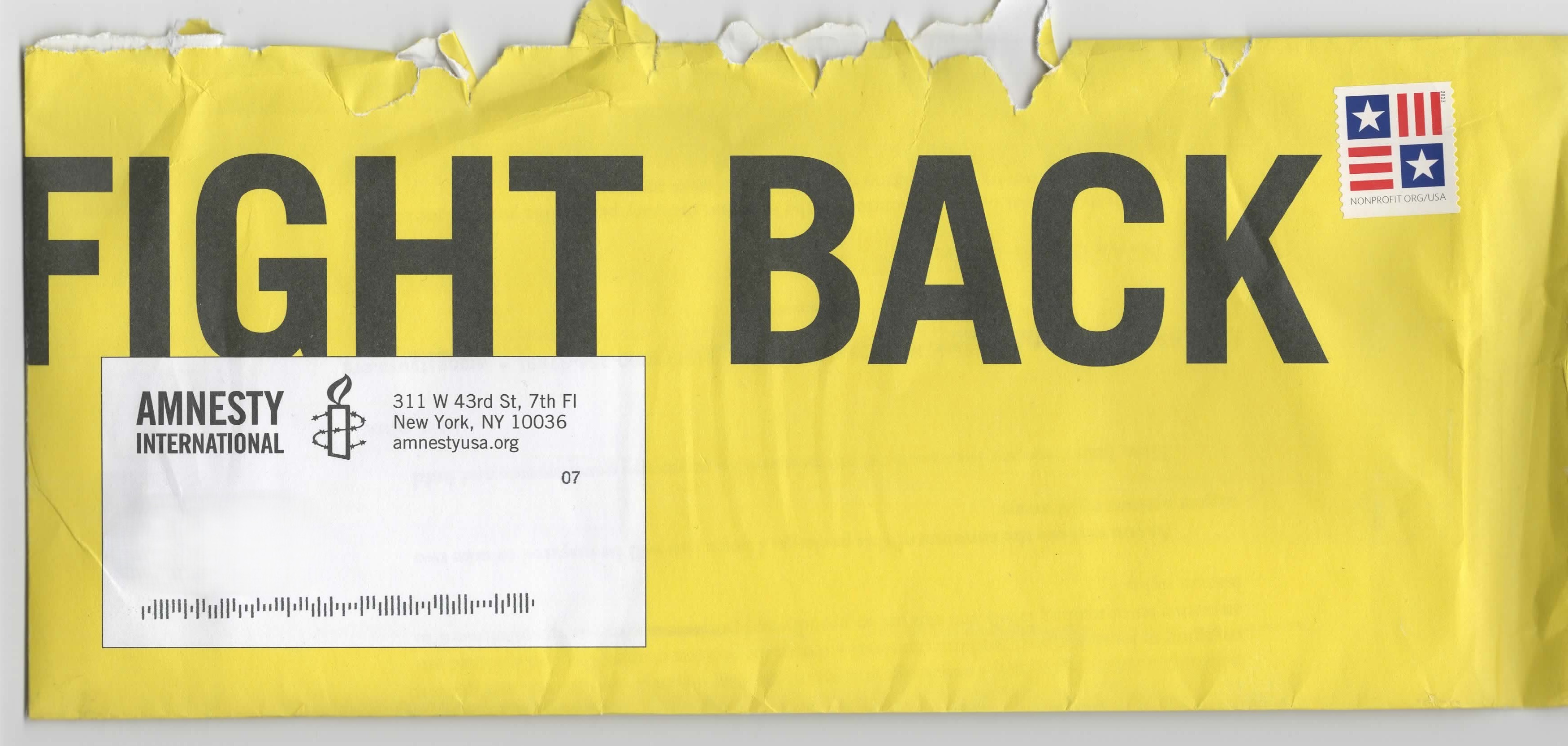
    Amnesty International is another example. The Trump administration stopped U.S. foreign aid, halting programs for health care, food security, shelter, and humanitarian support. And ended  funding for programs supporting survivors of sexual violence, refugees, and marginalized communities.

    Amnesty International has said that these cuts will leave millions without essential services.

    So they’re firing up their donors too.

    EPSON MFP image

    Both of these appeals are following a bold, in-your-face strategy to get noticed, get the appeal opened, and move donors.

    There’s the oversize outer envelope (11” x 5” for one and 11-1/2” x 5 for the other).

    There’s the simple, powerful messaging on the outer envelope: “Fight Back!”

    There’s the bold graphic approach, with huge fonts and attention-grabbing reds and yellows.

    And there’s the invitation to take action. The Amnesty International carrier touts an “activist tool kit inside.” And the Environmental Defense Fund envelope announces, “Petitions Inside!”

    Inside, the letters continue the “take action” theme, urging donors to donate and to get involved.

    You can see the strategy in both of these outer envelopes. They’re all about demanding attention, increasing the open rate, and getting donors motivated. When you see an appeal envelope like this in your mailbox, you know it’s something important. Your interest has been piqued. Your ire has been roused. And your means for fighting back are right at hand, inside the envelope.

    These are tactics and strategies that virtually all nonprofits could use in their appeals, especially now when there’s so much chaos and uncertainty.

    That’s why, as this turmoil continues and as the economy inches closer toward recession, nonprofits will have to grab donors’ attention and motivate them like never before. And that means direct mail tactics likes these will become necessary not only for success but also for survival.

    See the whole story at https://www.nonprofitpro.com/post/how-2-nonprofits-are-using-direct-mail-to-get-donors-fired-up-to-take-action/

  • Don’t hide from your donors — communicate with them

    You really should be mailing and emailing your donors more often. Why? Because…

    Your donors want to hear from you. They want to know what your nonprofit is doing. They want to know when their help is needed. They want to donate. And they expect to donate because they understand how nonprofits operate. If they didn’t, they wouldn’t be on your donor rolls in the first place.

    So, of course they expect to get your fundraising appeals. Still, what about the dreaded too-much-mail complaint?

    Simple. You can respond to it by respecting donors’ individual preferences. And offering them your sustainer program as an option for receiving less mail.

    Here’s the point: It does your nonprofit no good to restrict the appeals you send and hide from your donors. Your fundraising isn’t an intrusion in your donors’ lives, as some nonprofits seem to believe. Your fundraising is how you have a relationship with your donors. In fact, for most of your donors, your fundraising is all they’ll ever see of your nonprofit. Sure, some donors go to events, and some take the tour. But for most of your donors, your fundraising IS your nonprofit.

    And it’s pretty hard to have a strong relationship with your donors – let alone build your nonprofit’s brand — if they only hear from you once or twice a year.

    Then again, it’s not just about mailing more. It’s about mailing smarter too. That means:

    Asking your donors how often they want to hear from you and through what media, and honoring their preferences.

    Mailing less to lower-dollar donors.

    Mailing more to higher-dollar donors and using appeals with specialized messaging and production values.

    Letting lower-dollar lapsed donors go while reactivating higher-dollar lapsed donors.

    Adding extra appeals during high-response times like Christmas, Thanksgiving, and year end.

    And adding a donor-centric newsletter with success stories about your donor’s support at work.

    What it comes down to is this: You have to get your message in front of your donors – repeatedly. Otherwise, they’re likely to forget all about you. That’s a much greater risk than an occasional complaint about too much mail or email. You can see more here: https://tinyurl.com/yr7mwacw

  • How and why to get the copy voice right in fundraising appeals

    Why would a nonprofit, say, one fighting climate change, use messaging like this for a fundraising appeal. …

    Dear Ms. Joan Sample,

    I am writing to you today from [charity], a dedicated advocate for climate action and environmental sustainability. As you may know, our planet is facing unprecedented challenges due to climate change, and the need for immediate action has never been more urgent.

    At [charity], we are committed to combating climate change through innovative projects, community engagement, and policy advocacy. Our recent initiatives include installing an array of solar panels, which have already made a significant impact. However, to continue this vital work, we need your support.

    … when they could use messaging like this instead …

    Dear Ms. Joan Sample,

    I am writing this appeal on a hot July afternoon.

    My 11-month-old son is playing at my feet as I do. I look at Joe and I look at the blazing heat outside and I wonder how I can avoid talking about the greenhouse effect in nakedly personal terms. 

    But why shouldn’t I? Why shouldn’t I tell you how much I fear for the world we’re preparing for Joe?

    The first appeal reads like a corporate memo coming out of the accounting department at IBM. It’s predictable, bland, and deadly boring.

    The second one reads like it was written by an actual living, breathing, feeling person. It hasn’t been reviewed to death by a committee. It’s honest, relatable, personal, and human. When you read it, it draws you in. And even better, it makes you more receptive to whatever will follow.

    That’s the reaction we want to elicit from donors, and it comes from using an engaging copy voice. Many nonprofits struggle to get this right, for a number of reasons.

    They feel they have to speak to donors from a position of expertise and authority about the cause. But then the copy becomes long and pretentious.

    They use industry jargon and buzz words like “food insecure.” But then the copy confuses donors and keeps them at arm’s length.

    They think that the appeal letter has to sound like the president or executive director. But then the copy talks past donors, not at them, because what the president thinks is motivating often isn’t what donors think is motivating.

    What it comes down to is this: donors, like most people, respond best to plain talk. That’s why good fundraising copywriting is conversational. It’s write-like-you-talk writing. Simple words, short sentences, short paragraphs, with contractions, sentence fragments, and all the rest.

    The appeal should read like it was written by a friendly, thoughtful person who’s concerned about an issue and hopes the reader will be too. That human connection builds a rapport with donors. And that turns into a relationship with donors. And donors who have a relationship with your nonprofit will likely give more and give more often, which means increases in revenue and retention. You can see more here: https://tinyurl.com/ye269hxe